
Gardens & Grounds

A uniquely warm atmosphere pervades the gardens and grounds of Ballyvolane, created by the mixture of mature deciduous trees, formal, semi-formal, walled and woodland gardens, not to mention the abundance of indigenous wildlife. Formerly a dairy farm, Ballyvolane literally translates from Irish as ‘the place of springing heifers’ and is testament to the fertility, richness and natural diversity of the land on which the estate lies. Justin’s late father Jer Green has been restoring, developing and maintaining the gardens for over sixty years. The results of his work are extraordinary. The snowdrop drifts just after Christmas reminds us spring is close, which is followed by groves of daffodils in February and March. In April, the magnolias and rhododendrons are in full bloom which is followed in May by more rhododendrons and azaleas and the Rock woodland garden is carpeted with glorious bluebells until mid June. Wisteria on the house and in the walled-garden is always a treat for the eyes and nose as is the laburnum arch. The extensive hydrangea plantations take over from July and flower right up to Christmas changing to sepia tones in the autumn. The leaves start to turn gold in the autumn and finally drop off by mid-December. The three-acre walled-garden is where we grow flowers, vegetables and fruit for the house. In 2016, we planted out quince, gage, damson, cherry, pear and old Irish apple varieties in a small orchard in the walled-garden. The south facing lawns are a wonderful setting in which to relax on a sun-lounger and soak up the magical atmosphere of Ballyvolane House or to have a snooze. The lakes were restored in 1996 by Justin’s mum Merrie and these have matured into a wonderful haven for wildlife including moorhens, mallard, teal, otters, kingfishers, dragonflies, amphibians and fish as well as somewhere to walk or swim.
The Cousin who couldn’t leave
The gardens and parkland were originally laid out in the regency style when the house was built in the early 18th century by the Pyne Family. The planting of the trees on the Estate was undertaken by Thomas Pennefeather, a cousin of the Pynes, who came to stay for a fortnight and remained there for forty years in the position of agent. He planted most of the mature deciduous trees in the gardens and surrounding parkland, nurturing them in their formative years and ensuring their lasting presence for the centuries to come.
Little People... Big Outdoors!

Ballyvolane is ideal for little people with vast grounds to get lost in, woods to explore, hens to feed, eggs to collect, donkeys to pet and lots more entertainment nearby such as Fota Wildlife Park, Blarney Castle, Leahy’s Open Farm and lots of sandy beaches on the east Cork and west Waterford coastline.
Formal Gardens
The formal gardens at Ballyvolane are on the south side of the house. Three tiered lawns extend southwards dissected by gravel paths lined with flowering magnolia. The banks blossom with snowdrops, crocuses and daffodils earlier in the year while in May, bluebells sprout from under the mighty copper beech behind the croquet lawn. A little rockery sits west of the bottom lawn while all around magnificent flowering trees and shrubs enclose a truly idyllic space.
The Walled Garden

Through a small gate east of the top lawn one enters the walled garden, a huge enclosed area, now half is pasture. The remaining cultivated area still retains the charm of a carefully nurtured ornamental space but it is predominantly a working and productive vegetable garden providing fruit, vegetables and herbs for the kitchen much of the year round. The huge walls that enclose the walled garden were built by the Pynes under the famine relief schemes in the early half of the 19th century - the carved capstone adorning the arch that stood at the end of a once much longer beech hedge dates the construction at 1828. In 2015, a tennis court and 7-a-side soccer pitch were added to the walled garden and in 2016, a new orchard was planted.
The Rock

The woodlands surrounding Ballyvolane provide ever changing and breathtaking scenes throughout the year. Just east of the north side of the house lies the rock, a small knoll, densely planted with native timbers reaching skywards for light, while at their base a path weaves through a carpet of bluebells from mid May.
The Ponds

The ornamental ponds below the front of the house were originally dug by hand in the 19th century and restored and reshaped nearly 30 years ago, after decades of being hidden beneath dense undergrowth and silt.
Today, they are well established and form an important part of the parkland landscape. They are also a wonderful repository for biodiversity, supporting a rich mix of aquatic plants, insects, birds and other wildlife.
As temperatures have risen, however, keeping on top of surface pond weed has become an increasing challenge, so their management and regeneration remain very much ongoing.
Jer’s Legacy in the Gardens
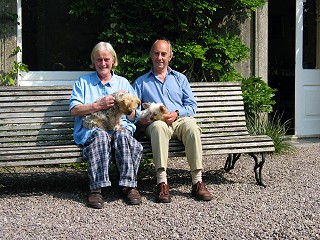
The gardens at Ballyvolane owe a huge amount to Jeremy Green - Jer.
When Jenny and Justin returned home in 2004, Justin’s father Jer stepped back from the day-to-day running of the house and turned his attention increasingly to the gardens. Over the next twenty years he restored the lakes, planted extensively, enlarged several areas and quietly improved the landscape year after year.
He loved the place and had a wonderful eye for how it could evolve over time. Much of what visitors enjoy in the gardens today is the result of that work.
Jer died in December 2025, but the gardens remain a very tangible part of his legacy - and, we think, they have never looked better.
Animal Life at Ballyvolane

Ballyvolane is home to a rich mix of wildlife and farm animals. With patience you may spot red squirrels or hedgehogs, while cattle graze the surrounding pastures alongside our two donkeys, Gin & Tonic. In the walled garden you’ll find rare-breed pigs, Muscovy ducks and hens (whose eggs stock the breakfast table), plus fan-tail doves in the aviary — and, of course, our ever-enthusiastic spaniels and terriers ready for a walk.
- Read ‘Archie, the largest cat in Munster’ by Pete the Vet. Archie was a well renowned feline resident of Ballyvolane for nearly 25 years!
- Read ‘Where to go and what to do at Ballyvolane’ by the Whisperer